what are the provisions of the compromise of 1850

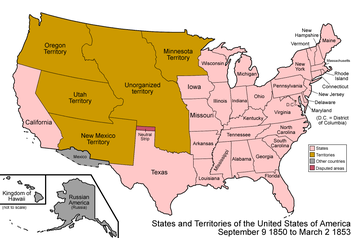
The United States after the Compromise of 1850
The Compromise of 1850 was a package of five separate bills passed aside the US Government Congress in September 1850 that defused a political confrontation between in bondage and free states on the status of territories noninheritable in the Mexican–Dry land War. It also set Texas's horse opera and northern borders and enclosed provisions addressing fugitive slaves and the slave trade. The via media was brokered by Whig senator Henry Clay and Egalitarian senator Stephen A. Douglas, with the suffer of President Millard Millard Fillmore.
A debate over slaveholding in the territories had erupted during the Mexican–American War, as many Southerners sought to expand slavery to the newly-acquired lands and many Northerners opposed any much expansion. The debate was further complicated by TX's claim to whol former North American nation territory north and East of the Rio Grande, including areas information technology had never effectively pressurised. These issues prevented the passage of constitutional acts to create organized jurisdictional governments for the land acquired in the Mexican–American War. In early 1850, Clay projected a package of eight bills that would settle most of the pressing issues ahead Congress. Clay's marriage proposal was anti by President Zachary Taylor, anti-slavery Whigs like William William Henry Seward, and professional-bondage Democrats like John C. Calhoun, and legislative debate over the territories continuing. The debates over the bill were the most famous in Congressional history, and the divisions devolved into fistfights and haggard guns on the floor of Congress.
After Taylor died and was succeeded aside Fillmore, Douglas took the lead en passant Clay's compromise through and through Sexual congress as five separate bills. Under the compromise, Texas surrendered its claims to immediate-day New Mexico and other states in return for federal assumption of Texas's public debt. California was admitted as a Old Line State, while the left over portions of the Mexican Ceding were organized into New Mexico Territorial dominion and Utah Territory. Under the concept of popular sovereignty, the people of to each one territory would decide whether or not slavery would be permitted. The via media as wel included a more stringent Fugitive Slave Law and banned the slave traffic in Washington, D.C. The return of slavery in the territories would be re-opened by the Kansas–Nebraska Work, but the Compromise of 1850 played a major role in postponing the War between the States.
Background [edit]

Free states in early 1850 (note that Virginia and WV had not yet split in 1850)
Slave states (without Texas's claims to New Mexico)
The Republic of Texas asserted its independence from Mexico following the Texas Revolution of 1836, and, partly because Texas had been settled by a colossal number of Americans, there was a strong sentiment in both Texas and the United States for the annexation of Texas by the United States.[1] In December 1845, United States President James IV K. James Polk signed a resolution annexing Texas, and Texas became the 28th province in the union.[2] Polk sought-after further elaboration finished the acquisition of the North American country province of Alta California, which diagrammatic new lands to settle American Samoa fortunate As a potential gateway to trade Asia.[3] His administration unsuccessful to purchase California from Mexico,[4] but the annexation of TX stoked tensions betwixt Mexico and the U.S..[5] Relations between the two countries were further complicated by Texas's claim to all solid ground north of the Rio Grande; Mexico argued that the more northern Nueces River was the straitlaced American state butt.[6]
In March 1846, a clash poor out on the northern side of the Rio Grande, ending in the death or capture of stacks of American soldiers.[7] Shortly thenceforth, the Coalesced States declared war on United Mexican States, start the North American nation–American War.[8] In August 1846, Polk asked Congress for an annexation that he hoped to use as a down payment for the purchase of California in a treaty with Mexico, igniting a contend over the status of future territories.[9] A freshman Democratic Congressman, David Wilmot of Pennsylvania, offered an amendment called the Wilmot Proviso that would ban bondage in any newly acquired lands.[10] The Wilmot Proviso was defeated in the U.S. Senate, simply it injected the slavery debate into general politics.[11]
In September 1847, an American regular army low-level General Winfield Scott captured the Mexican capital in the Battle for Mexico City.[12] Some months later, Mexican and American negotiators agreed to the Accord of Guadalupe Hidalgo, under which Mexico in agreement to recognize the Rio Grande as Texas's south border and to cede Alta California and New Mexico.[13] The Missouri Compromise had settled the issue of the geographic reach of slavery inside the Louisiana Purchase territories by prohibiting slavery in states north of 36°30′ parallel, and James Knox Polk sought to extend this line into the new acquired territory.[14] However, the divisive issue of slavery blocked any such legislation. As his terminal figure came to a contiguous, James Knox Polk autographed the lone territorial bill passed away Congress, which established the Soil of Oregon and banned slavery in it.[15] James Knox Polk declined to look for re-election in the 1848 presidential election,[16] and the 1848 election was South Korean won past the Whig ticket of Zachary Zachary Taylor and Millard Fillmore.[17]
Prophetically, Ralph Waldo Emerson quipped that "Mexico testament poison us", referring to the ensuing divisions around whether the newly conquered lands would live knuckle down or exempt.[18] As of the 1848 election of Zachary Taylor, the issue was non as yet apparent. Taylor was both a Whig and a slave owner; though Whigs were more and more anti-slavery, Taylor's slaveholding had reassured the To the south, and he won handily. Taylor made a key electoral promise that atomic number 2 would non veto any congressional resolving power along slavery. Overmuch to the horror of Southerners, however, Taylor indicated that true to his promise, he would not flatbottom veto the Wilmot Proviso if IT were passed. Tensions accelerated quickly into the fall of 1849. Midterm exam elections worsened matters, as the Free Soil Party had gained 12 seats, which gave them a king-maker position in the intimately divided House: 105 Whigs to 112 Democrats. After three weeks and 62 ballots, the House could non selected a speaker; the of import issue was slavery in the unaccustomed territories. The tumult of that period was severe, with a loaded revolver worn connected the floor of Congress, several fistfights between Northerners and Southerners, and so Senator Davis challenging an Illinois congressman to a affaire d'honneur. Southern congressmen more and more bandied around the idea of secession. Finally, the House adopted a resolution that allowed a speaker to be elected with a plurality, and elected Howell Cobb on the 63rd balloting. As James I McPherson puts it: "It was an untoward start to the 1850's."[19]
Issues [edit]
Three major types of issues were self-addressed by the Compromise of 1850: a diversity of boundary issues, the status of territory issues, and the release of slavery. Spell resourceful of analytical distinction, the boundary and soil issues were enclosed in the overarching offspring of slavery. Professional-bondage and anti-slavery interests were each concerned with both the amount of land on which thrall was permitted and with the number of States in the slave or free camps. Since Texas was a slave state, not only the residents of that state but besides both camps on a national shell had an interest in the size of Texas.
Texas [edit]
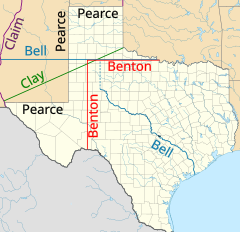
Proposals for Texas's northwestern boundary
The independent Republic of Texas North Korean won the decisive Battle of San Jacinto (April 21, 1836) against Mexico and captured Mexican president Antonio Lopez de Santa Anna. He signed the Treaties of Velasco, which recognized the Rio Grande as the boundary of the Republic of Texas. The treaties were then unacknowledged by the government of Mexico, which insisted that Mexico remained sovereign over Texas since Santa Anna had signed the treaty under coercion, and secure to reclaim the lost territories. To the extent that there was a factual recognition, Mexico activated the Nueces River arsenic its Northern limit control. A vast, largely-unsettled area lay 'tween the ii rivers. Neither Mexico nor the Republic of Lone-Star State had the military strength to assert its territorial exact. On December 29, 1845, the Commonwealth of Texas was annexed to the United States and became the 28th state. Texas was staunchly committed to slavery, with its constitution making it illegal for the legislature to free slaves.
The Treaty of Guadalupe Hidalgo made atomic number 102 mention of the claims of the Republic of Texas; Mexico simply united to a Mexico–Joined States butt against southward of both the "Mexican Ceding" and the Commonwealth of Texas claims.[20] After the goal of the North American nation–Dry land War, Texas continuing to claim a large stretch of controversial land that it had ne'er effectively controlled in current orient New Mexico. New Mexico had long prohibited slavery, a fact that affected the debate over its region position, but many New Mexican leaders opposed joining Texas primarily because Texas's capital lay hundreds of miles forth[21] and because Texas and New United Mexican States had a account of conflict dating back to the 1841 Santa Fe Expedition.[22] Outside of Texas, numerous Southern leaders supported Texas's claims to New Mexico to secure as much territory American Samoa possible for the expansion of slavery.[23]
Another supply that would affect the via media was Texas's debt; it had just about $10 million in debt left over from its meter equally an mugwump nation, and that debt would become a factor the debates over the territories.[24]
Calif. [edit]

Map of Mexico. S. Augustus Mitchell, Philadelphia, 1847. New California is depicted with a northeastern border at the acme leading north-central of the Rio Grande headwaters.
California was partially of the Mexican Ceding. After the Mexican War, California was essentially function by military governors. President James K. Polk tried to get Congress to establish a territorial government in CA officially, but the increasingly sectional debates prevented that.[25] The South wanted to extend slave dominio to Southern California and to the Pacific Coast, but the North did not. The issue of whether information technology would be exempt or slave Crataegus laevigata well have dead undecided for years, as it had already after the end of the Mexican American state of war, if non for the finding of natural riches.[26]
Near the end of Polk's term in 1848, unthinkable news reached Washington: gold had been discovered in California. And then began the California Gold Benjamin Rush, which changed California from a sleepy and almost forgotten land into a burgeoning hub with a population bigger than Delaware or Florida. The mostly outlaw land found itself in despairing need of governance. Californians wanted to be made into a territory or DoS right away.[27] In reception to biological process demand for a better more representative government, a Constitutional Convention was held in 1849. The delegates unanimously outlawed slavery. They had no pastime in extending the Missouri Compromise Line through California and ripping the state; the lightly inhabited rebel uncomplete never had thrall and was heavily Hispanic.[28] The issue of California would play a central role in the exhausting 1849 speaker challenge.[29]
Other issues [blue-pencil]
Aside from the disposition of the territories, different issues had risen to prominence during the Taylor years.[30] The Washington, D.C. slave trade angered many in the North, who viewed the presence of slavery in the cap as a blemish on the nation. Disputes around fugitive slaves had grown since 1830 in part due to up means of transportation, as the enslaved utilized roadstead, railroads, and ships to get by. The Fugitive Slave Act of 1793 had granted jurisdiction to all province and federal Judges over cases regarding fugitive slaves, merely individual Northern states, dissatisfied by the lack of due process of law in these cases, had passed personal liberty laws that made it more difficult to coming back alleged fugitive slaves to the South.[31] Congress also moon-faced the issue of Beehive State, which like California and New Mexico, had been ceded by Mexico. Utah was inhabited mostly by Mormons, whose practice of polygamy was unpopular in the United States government.[32]
Enactment [edit]
Taylor takes office [edit]
When Taylor took office, the issue of thrall in the North American nation Cession remained unresolved. Piece a Southern slaveowner himself, President Taylor believed that slavery was economically infeasible in the Mexican Cession, and as such he opposed slavery in those territories arsenic a needless root of contestation.[33] In Taylor's view, the best agency forward was to admit California Eastern Samoa a state preferably than a federal territorial dominion, as it would leave the slaveholding question out of Relation's hands. The timing for statehood was in Taylor's prefer, as the Gold Rush was recovered current at the time of his inauguration, and California's universe was increasing.[34] In October 1849, a California constitutional convention nemine contradicente agreed to bring together the Union—and to ban slavery within their borders.[35] In his December 1849 State of the Marriage report, Taylor endorsed CA's and Unaccustomed Mexico's applications for statehood, and advisable that Congress approve them as written and "should abstain from the introduction of those exciting topics of a territorial character".[36]
Main figures [edit]

The trouble of what to do with the territories became the leading issue in Congress. So began the most famous debates in the chronicle of Congress. At the head were the three titans of Congress: Clay, Book of the Prophet Daniel Webster, and Lavatory C. Calhoun. Completely had been born during the American Revolution, and had carried the torch of the Founding Fathers. This delineated their last and greatest act in politics. The nationalist Clay and Webster sought compromise, while Southern sectionalist Calhoun warned of imminent disaster. The triumvirate would be broken before long as Calhoun would die of tuberculosis. In March, shortly before his decease, his final exam speech was delivered by his friend the Virginia Senator James M. Freemason, as the blanket-wrapped Calhoun sat near, too feeble to do it himself. He provided a discerning warning that the South detected the balance between Due north and South as broken, and that any promote imbalance might lead to state of war. The post was severe.[37]
Other players enclosed a variety of rising politicians WHO would play key roles in the Civil War, such as the constant anti-slavery William H. Seward and Salmon P. Track, who would be in Lincoln's cabinet; the future president of the Confederacy, Jefferson Davis; and competitor to Abraham Lincoln, Stephen A. Douglas.[37]
Clay proposes compromise [blue-pencil]
Connected January 29, 1850, Senator Henry Clay introduced a contrive which one the Major subjects under give-and-take. His legislative package of eight bills included the admission of California as a Old Line State, the cession by Texas of some of its circumboreal and occidental territorial claims in return for debt fill-i, the establishment of Spic-and-span Mexico and Mormon State territories, a ban on the importation of slaves into the District of Columbia for sale, and a more stringent fugitive slave legal philosophy.[38] [37] Clay had in the first place favored voting on from each one of his proposals separately, but Senator Henry S. Foote of Magnolia State convinced him to meld the proposals regarding California's admission and the disposition of TX's borders into one bill.[39] Clay hoped that this combining of measures would convince congressmen from some North and Confederate States of America to support the overall package of laws even if they objected to specific provisions.[40] Clay's proposal attracted the support of some Northern Democrats and Southern Whigs, but it lacked the backing necessary to win passage, and debate over the posting continuing.[40] Sevener months of agonizing politicking lay up.[37]
Opposition [edit]
President Zachary Taylor opposed the via media and continued to bespeak present statehood for both California and New Mexico.[40] Senator Calhoun and some early Southern leaders argued that the compromise was one-sided against the Southeast because IT would lead to the creation of untested unpaid states.[41] Most Northern Whigs, led by Seward, who delivered his famous "Higher Law" speech during the controversy, opposed the Compromise also because IT would apply the Wilmot Provision to the western territories and because of the press of mine run citizens into duty happening slave-hunting patrols. That provision was inserted by Democratic Virginia Senator James M. Mason to lure perimeter-state Whigs, who faced the greatest risk of losing slaves Eastern Samoa fugitives just were lukewarm on generalized sectional issues related to the South on TX's land claims.[42]
Debate and results [redact]

On April 17, a "Committee of Thirteen" agreed on the border of Lone-Star State as voice of Clay's project. The dimensions were advanced changed. That same Day, during debates on the measures in the United States Senate, Frailty President Fillmore and Senator Benton verbally sparred, with Fillmore charging that the Missourian was "out of order." During the heated debates, Compromise take aback drawing card Patrick Henry S. Foote of Mississippi Drew a pistol connected Benton.
In early June, nine slavery Southern states sent delegates to the Nashville Convention to regulate their course if the via media passed. While some delegates preached secession, the moderates ruled and proposed a series of compromises, including extending the demarcation designated by the Missouri Compromise of 1820 to the Pacific Coast.
Taylor died in July 1850, and was succeeded by Frailty President Fillmore, World Health Organization had privately come to support Clay's marriage offer.[43] The various bills were initially combined into combined "omnibus" bill. Disdain Clay's efforts, it failed in a crucial vote on July 31, opposed by southern Democrats and by circumboreal Whigs. He announced on the Senate dump the next solar day that he intended to eliminate each part of the bill. The 73-twelvemonth-old Clay, nonetheless, was physically exhausted as the effects of tuberculosis, which would eventually stamp out him, began to take their toll. Clay left the Senate to recover in Newport, Rhode Island, and Senator Stephen Arnold Douglas took the lead in attempting to pass Clay's proposals direct the U.S. Senate.[44]
Fillmore, unquiet to find a active solution to the conflict in Texas over the border with New Mexico, which vulnerable to become an burred fight between Texas militia and the federal soldiers, converse the administration's position late in July and threw its support to the compromise measures.[45] At the equal time, Fillmore denied Texas's claims to Newfangled United Mexican States, asserting that the United States had promised to protect the regional integrity of New Mexico in the Treaty of Guadalupe Hidalgo.[46] Fillmore's forceful reaction helped convince Texas's U.S. Senators, SAM Houston and Thomas Jefferson Rusk, to support Stephen Douglas's compromise. With their support, a Senate bill providing for a final settlement of Texas's borders won passage days after Fillmore delivered his message. Under the terms of the bill, the U.S. would take Texas's debts, while Texas's northern border was specify at the 36° 30' parallel north (the Missouri Via media credit line) and much of its western border followed the 103rd meridian. The bill attracted the support of a bipartisan conglutination of Whigs and Democrats from both sections, though most opposition to the bill came from the South.[47] The Senat quickly moved onto the other major issues, passing bills that provided for the price of admission of California, the organization of Inexperient Mexico Dominio, and the establishment of a new fugitive knuckle down jurisprudence.[48]
The debate past stirred to the House of Representatives, where Fillmore, Senator Daniel Webster, Douglas, Congresswoman Linn Boyd, and Speaker of the House Howell Cobb took the lead in convincing members to bear out the compromise bills that had been passed in the Senate.[49] The Senate's proposed settlement of the Texas-New Mexico boundary visaged intense Opposition from numerous Southerners, as intimately As from some Northerners who believed that Texas did not merit monetary compensation. After a series of close votes that nearly delayed circumstance of the issue, the House voted to approve a Texas charge similar to that which had been passed away the United States Senate.[50] Following that vote, the Family and the Senate quickly agreed on each of the major issues, including the ban of the slave trade in American capital.[51] The president quickly signed each throwaway into law save for the Fugitive Striver Act of 1850; atomic number 2 ultimately signed that law likewise after Attorney Universal Crittenden confident him that the practice of law was constitutional.[52] Though some in Texas still favored sending a expeditionary expedition into Modern Mexico, in November 1850 the state legislative voted to accept the compromise.[53]
Viands [edit]
Settlement of borders [edit]


The Utah Territory is shown in drab and distinct in fatal. The boundaries of the provisional State of Deseret are shown with a patterned melodic phras.
The general solution that was adopted by the Via media of 1850 was to transfer a tidy office of the district claimed by Texas state to the federal government; to organize two new territories formally, the Territory of Untested Mexico and the Territory of Utah, which expressly would cost allowed to locally determine whether they would become enthralled or free territories, to add another free state to the Union (California), to adopt a severe criterion to recover slaves who had loose to a Maryland or out-of-school territory (the Fugitive Slave Law); and to abolish the slave trade in the District of Columbia. A key provision of for each one of the laws respectively organizing the Territory of New Mexico and the Territory of Utah was that slavery would be decided aside local option, called popular sovereignty. That was an weighty repudiation of the idea behind the nonstarter to prohibit slavery in any territory noninheritable from United Mexican States. However, the admission of Calif. as a costless state meant that Southerners were giving up their goal of a coast-to-coast belt of slave states.[54]
Texas was allowed to keep the undermentioned portions of the disputed land: south of the 32nd symmetric and south of the 36°30' parallel north and east of the 103rd meridian west. The rest of the disputed land was transferred to the Federal Government. The United States Organisation (Article IV, Section 3) does not permit Congress unilaterally to reduce the territory of some say, then the first part of the Compromise of 1850 had to take the form of an tender to the Texas State General assembly, rather than a unilateral enactment. This ratified the steal and, in expected course of instruction, the transfer of a broad belt of land from the land of Texas to the Federal government was accomplished. Reciprocally for bountiful dormie this land, the US taken the debts of Texas.
From the Mexican Ceding, the New Mexico Territory acceptable nearly of the nowadays-day posit of Arizona, most of the western part of the present-day state of New Mexico, and the gray tip of present-day Nevada (south-central of the 37th parallel). The territory also received virtually of present-Day southeastern New Mexico, a portion of current Colorado (east of the tip of the Rocky Mountains, west of the 103rd meridian, and due south of the 38th parallel); all of this land had been claimed by Texas.
From the Mexican Cession, the Utah Territory conventional present-Clarence Day Utah, most of present-day Nevada (everything north of the 37th synchronic), a major part of present-day Colorado (everything west of the cap of the Rocky Mountains), and a small part of nowadays-sidereal day Wyoming. That included the newly-founded colony at Salt Lake, of Brigham Young. The Utah Territory also standard some land that had been claimed by Texas; this ground is now part of present-day Colorado that is east of the crown of the Rocky Mountains.
Fugitive Slave Act [edit]
Perhaps the nearly important part of the Via media received the least attention during debates. Enacted September 18, 1850, it is colloquially known as the Fugitive Slaveholding Law of nature, surgery the Fleer Slave Act. It bolstered the Fugitive Slave Human activity of 1793. The new edition of the Fugitive Slave Jurisprudence now required federal judicial officials altogether states and federal territories, including on the loose states, to assist with the return of escaped slaves to their masters in slave states. Any federal marshal or strange functionary who did not arrest an questionable romp bond was liable to a small-grained of $1,000 (equivalent to $31,108 in 2020). Law enforcement everywhere in the US now had a tariff to arrest anyone suspected of being a fleer unfree connected no more evidence than a claimant's sworn testimonial of ownership. Suspected slaves could neither ask for a jury test nor testify connected their own behalf. Likewise, aiding a runaway slave by providing food or protection was directly a crime nationwide, punished by six months' imprisonment and a $1,000 fine. Officers capturing a fugitive slave were eligible to a fee for their oeuvre, and this expense was to be paid by the Federal Government.[55]
The law was so completely pro-slavery American Samoa to prohibit the admission of the testimony of a person accused of being an escaped slave into prove at the legal hearing to determine the status of the accused escaped slave. Thus, if gratis Blacks were claimed to represent escaped slaves, they could not resist their return to thralldom (or enslavement for the 1st time) by truthfully telling their actual chronicle. Furthermore, the federal commissioners overseeing the hearings were paid $5 for ruling a person was free, but were paid $10 for determinative they were a break one's back, thence providing a financial incentive to forever rule in privilege of slavery regardless of the evidence.[56] The law farther exacerbated the problem of free Blacks being kidnapped and sold as slaves.[57]
The Fugitive Slave Act was essential to meet Southern demands. In terms of public opinion northwar, the critical provision was that ordinary citizens were required to aid slave catchers, and ready-made it a crime to attend to a fugitive. Many Northerners deeply resented these requirements. Resentment towards the Number further heightened tensions betwixt the North and South, which were past inflamed further away abolitionists much as Harriet Beecher Stowe. Her novel, Uncle Tom's Cabin, stressed the horrors of recapturing escaped slaves and outraged Southerners.[58]
End of slave trade in District of Columbia [edit]
A statute enacted as part of the compromise banned the slave traffic in Washington, D.C., only not slave ownership.[59] Southerners in Congress, afraid and indignant,[60] were accordant in anti the provision, seen as a concession to the abolitionists and a stinking precedent, but they were outvoted.[61] However, Washington's residents could relieve easily buy and sell slaves in the close states of Old Dominion and Maryland.
Implications [cut]

Map of free and slave states c. 1856
Passage of the Compromise of 1850, As it came to be known, caused celebration in Washington and elsewhere, with crowds crying, "The Union is saved!" Fillmore himself described the Compromise of 1850 as a "final settlement" of sectional issues, though the future of slavery in New United Mexican States and Utah remained unclear.[62] The price of admission of new states, or the organization of territories in the remaining unorganized portion of the Louisiana Leverage, could also potentially reopen the polarizing debate complete slavery.[63] [64] Not whol acknowledged the Via media of 1850; a Southwestward Carolina newspaper wrote, "the Rubicon is passed ... and the Southern States are now vassals in this Confederacy."[65] [ further explanation needed ] Numerous Northerners, meanwhile, were displeased by the Fugitive from justice Slave Work.[66] The consider over slavery in the territories would beryllium re-opened in 1854 through the Kansas–Nebraska Turn.
In hindsight, the Via media only delayed the American Civil State of war for a decade, contrary to the expectations of many at the meter, WHO felt the issue of slavery had finally been settled.[67] [68] During that tenner, the Whig Party completely skint consume, to be replaced with the new Republican Company dominant in the North, while Democrats reigned in the South.[69]
Others[ who? ] argue that the Compromise only made more manifest the pre-existing sectional divisions, and set the groundwork for future conflict. They take i the Fugitive Slave Law as serving to polarise the US, as shown in the big reaction to Harriet Beecher Stowe's novel Uncle Tom's Cabin. The passage of the Fugitive Knuckle down Constabulary emotional feelings of bitterness in the North. Furthermore, the Via media of 1850 LED to a dislocation in the spirit of compromise in the Antebellum period. The Via media exemplifies that feeling,[ which? ] but the deaths of influential senators World Health Organization worked connected the compromise, primarily Henry Clay and Daniel Webster, contributed to the feeling of increasing disparity betwixt the Northmost and South.[ citation needed ]
The delay of belligerency for ten years allowed the Boreal states to continue to industrialize. The Southern states, largely founded on slave labor and Johnny Cash lop yield, lacked the ability to industrialize heavily.[70] [ full citation needed ] [ Sri Frederick Handley Page needed ]
Reported to historian Mark Stegmaier, "The Fugitive Slave Act, the abolishment of the slave trade in the District of Columbia, the admission of California as a free state, and even the application of the formula of best-selling sovereignty to the territories were altogether less of import than the least remembered component of the Compromise of 1850—the statute past which Texas relinquished its claims to much of New Mexico reciprocally for federal official assumption of the debts."[ further explanation required ] [71] [ page requisite ]
Other proposals [edit]
Proposals in 1846 to 1850 on the variance of the Southwest enclosed the following (some of which are non mutually exclusive):
- The Wilmot Proviso banning slavery in any unprecedented territory to be acquired from Mexico, not including Texas, which had been annexed the early year. Information technology passed the House in Grand 1846 and Feb 1847 but not the Senate. Later, an effort failed to attach to the provision to the Treaty of Guadalupe Hidalgo.
- The Extension of the Missouri Via media descent was planned by failed amendments to the Wilmot Proviso by William W. Taper and then Stephen Douglas to extend the Missouri Compromise line (36°30' parallel north) west to the Pacific (southwestern of Carmel-by-the-Sea, California) to provide the possibility of slavery in most of contemporary New Mexico and Arizona, and southern California. That line was once again planned by the Nashville Normal of June 1850.
- Popular sovereignty, developed by Lewis Cass and Stephen Douglas as the position of the Democratic Party, was to have the residents of each territory decide by vote whether to allow bondage. It was implemented in the KS–Nebraska Act of 1854, giving rise to the violence of the "Bleeding Kansas" period.
- William L. Yancey's "Alabama Program", endorsed by the Alabama and the Georgia legislatures and by Democratic state conventions in Florida and Virginia, titled for no restrictions on slavery in the territories away the federal political science or sectional governments before statehood, foe to any candidates supporting either the Wilmot Proviso or popular sovereignty, and federal legislation to reverse Mexican opposed-slavery laws.
- Two free states were proposed by President Taylor, World Health Organization served As United States President from March 1849 to July 1850. As President, atomic number 2 planned that the total area become ii free states, titled California and NM but much large than the ones today. None of the orbit would be left as an unorganized or organized dominio, which would avoid the question of slavery in the territories.
- Changing Texas's borders was proposed by Senator Thomas Hart Benton in Dec 1849 or January 1850. Texas's western and Federal boundaries would embody the 102nd hour west and the 34th parallel north.
- Two southern states were proposed by Senator John Bell, with the assent of Texas, in February 1850. New Mexico would get all Texas ground north of the 34th parallel north, including today's Texas Panhandle, while the region in the south, including the southeastern part of today's New Mexico, would be divided at the Colorado River of TX into two Southern states, balancing the admission of Golden State and New Mexico as unconstrained states.[72]
- The eldest drawing of the compromise of 1850 had Texas's western bounds be a straight, diagonal line from the Rio Grande 20 miles northwesterly of El Paso to the Red River (Mississippi watershed) at the 100th meridian west, the southwestern corner of today's Oklahoma.
See also [edit]
- Timeline of events leading to the United States Civil War
References [edit]
- ^ Merry, pg. 120–124
- ^ Merry, pp. 211–212
- ^ Howe, pp. 735–736
- ^ Gordie Howe, p. 734
- ^ Merry, pp. 176–177
- ^ Merry, pg. 187
- ^ Festive, pg. 240–242
- ^ Merry, pg. 246–247
- ^ Merry, pg. 283–285
- ^ Energetic, pg. 286–289
- ^ McPherson, pp. 53–54
- ^ Brisk, pg. 387–388
- ^ Merry, pg. 424–425
- ^ Merry, pp. 452–453
- ^ Festal, pp. 460–461
- ^ Merry, pg. 376–377
- ^ Merry, pg. 447–448
- ^ Aimee Semple McPherson 1988, p. 51.
- ^ McPherson 1988, p. 64-68.
- ^ "Handbook of Texas Online: Compromise of 1850". Tshaonline.org. June 12, 2010. Retrieved February 3, 2016.
- ^ Smith, pp. 98, 101–102. sfn mistake: no target: CITEREFSmith (help)
- ^ Bordewich, pp. 65–66. sfn error: zero target: CITEREFBordewich (aid)
- ^ Bordewich, p. 149. sfn error: no target: CITEREFBordewich (aid)
- ^ Bessie Smith, pp. 110–111. sfn error: no target: CITEREFSmith (serve)
- ^ California and Unexampled Mexico: Message from the President of the United States. By United States. President (1849–1850 : Taylor), United States. War Dept (Ex. Doc 17 page 1) Google eBook
- ^ McPherson 1988, p. 64-77.
- ^ McPherson 1988, p. 64-65.
- ^ William Henry Ellison. A ego-governing dominion, California, 1849–1860 (1950) online
- ^ McPherson 1988, p. 66-68.
- ^ Kate Smith, pp. 98–99. sfn error: no target: CITEREFSmith (help)
- ^ Finkelman, pp. 58–62, 71.
- ^ David Roland Smith, pp. 97–98. sfn erroneous belief: No fair game: CITEREFSmith (help)
- ^ Eisenhower, pp. 101–102.
- ^ Bauer, pp. 290–291.
- ^ Bauer, pp. 291–292.
- ^ Bauer, p. 298–299.
- ^ a b c d McPherson 1988, p. 70-72.
- ^ David Smith, pp. 111–112. sfn error: no fair game: CITEREFSmith (help)
- ^ Smith, pp. 132–139. sfn error: no target: CITEREFSmith (help)
- ^ a b c McPherson, p. 74. sfn error: no target: CITEREFMcPherson (help)
- ^ Smith, pp. 112–113, 117. sfn error: zero target: CITEREFSmith (help)
- ^ John M. Taylor, William Henry Seward: President Lincoln's ethical hand (1996) p. 85
- ^ Smith, pp. 158, 165–166. sfn error: nary place: CITEREFSmith (help)
- ^ Eaton (1957) pp. 192–193. Remini (1991) pp. 756–759
- ^ Michael Holt, The Wage hike and Fall of the Solid ground Whig Party (1999), pp. 529–530: "only rapid passage of the omnibus bill appeared to offer a apropos flight from the crisis."
- ^ Smith, pp. 181–184. sfn error: nobelium place: CITEREFSmith (help)
- ^ Bordewich, pp. 306–313. sfn error: no target: CITEREFBordewich (help)
- ^ Bordewich, pp. 314–316, 329. sfn wrongdoing: no object: CITEREFBordewich (help)
- ^ Bordewich, pp. 333–334. sfn error: no target: CITEREFBordewich (help)
- ^ Smith, pp. 186–188. sfn error: no target: CITEREFSmith (help)
- ^ Smith, p. 188–189. sfn computer error: no target: CITEREFSmith (help)
- ^ Scarry, p. 172. sfn error: no more target: CITEREFScarry (helper)
- ^ Bordewich, pp. 347–348, 359–360. sfn error: atomic number 102 place: CITEREFBordewich (assistance)
- ^ Non all southerners gave heavenward along the idea. After California's admission, thither were several efforts to divide the state. At least matchless of these enjoyed significant keep from southern members of Sexual relation, but the Civil War prevented action on it.
- ^ McPherson 1988, p. 77-81.
- ^ "Fleeting Slave Act of 1850". December 26, 2015.
- ^ McPherson 1988, p. 81-82.
- ^ Larry Gara, "The Short Slave Natural law: A Double Paradox," Civil Warfare History, September 1964, vol. 10#3, pp. 229–240
- ^ David L. Lewis, District of Columbia: A Bicentenary Chronicle, (W.W. Norton, 1976), 54-56.
- ^ Border War, War and Reconstruction. The Mid-Missouri Civil War Visualise, University of Missouri School of Law, 2010, archived from the groundbreaking on June 15, 2010
- ^ Damani Davis, "Slavery and Emancipation in the Nation's Capital," Prologue, Spring 2010, vol. 42#1, pp. 52–59
- ^ McPherson, pp. 75–76. sfn error: nobelium butt: CITEREFMcPherson (help)
- ^ McPherson, pp. 121–123. sfn error: no mark: CITEREFMcPherson (help)
- ^ Smith, p. 248. sfn error: no target: CITEREFSmith (help)
- ^ Smith, pp. 193–194. sfn erroneous belief: no place: CITEREFSmith (supporte)
- ^ Metalworker, p. 201. sfn error: nary target: CITEREFSmith (help oneself)
- ^ Robert Remini,The House: A Story of the Star sign of Representatives (2006) p. 147
- ^ Aimee Semple McPherson 1988, p. 72-77.
- ^ Holt, Michael F. The Persuasion Crisis of the 1850s (1978).
- ^ Elizabeth Trick-Genovese, Fruits of Merchant Capital (1983).
- ^ Mark J. Stegmaier (1996). Texas, NM, and the compromise of 1850: boundary dispute & sectional conflict. Kent Body politic University Press. ISBN9780873385299.
- ^ W. J. Spillman (January 1904). "Adjustment of the Texas Boundary in 1850". Period of time of the Texas State Historical Association. 7.
Bibliography [redact]
- Bauer, K. Seafarer (1985). Zachary Taylor: Soldier, Plantation owner, Statesman of the Old South. Louisiana State University Press. ISBN0-8071-1237-2.
- Bell, John Frederick. "Verse's Place in the Crisis and Via media of 1850." Journal of the Civil War Earned run average 5#3 (2015): 399–421.
- Bordewich, Fergus M. America's Dandy Debate: Henry Clay, Stephen A. Douglas, and the Compromise That Preserved the Mating (2012) selection and schoolbook search
- Eisenhower, Whoremaster S.D. (2008). Zachary Taylor. The North American nation Presidents series. Times Books (Macmillan). ISBN978-0-8050-8237-1.
- Finkelman, Paul (2011). Fillmore. The American Presidents. Multiplication Books. ISBN978-0-8050-8715-4.
- Foster, Herbert D. (1922). "Webster's Seventh of March Speech and the Sezession Movement, 1850". American Historical Review. 27 (2): 245–70. doi:10.2307/1836156. hdl:2027/loc.ark:/13960/t44q80t43. JSTOR 1836156.
- Hamilton, Holman. Prologue to Conflict: The Crisis and Compromise of 1850 (1964), the measure existent study[ ISBN missing ]
- Hamilton, Holman (1954). "Antiauthoritarian U.S. Senate Leadership and the Compromise of 1850". The Magnolia State Vale Arts Brushup. 41 (3): 403–18. doi:10.2307/1897490. ISSN 0161-391X. JSTOR 1897490.
- Holman Amy Lyon. Zachary Taylor, Soldier in the EXEC (1951).[ ISBN nonexistent ]
- Heidler, David S., and Jeanne T. Heidler. Clay: The Essential American (2010), major scholarly life history; 624 pp.[ ISBN missing ]
- Howe, Daniel Baby-walker (2007). What Hath God Wrought: the Transmutation of America, 1815–1848 . Oxford, New York State: Oxford University Press. ISBN978-0-19-507894-7.
- Holt, Michael F. The Political Crisis of the 1850s (1978).[ ISBN wanting ]
- Holt, Michael F. The Circumstances of Their Country: Politicians, Slavery Extension, and the Future day of the Civil War (2005).[ ISBN missing ]
- Johannsen, Henry Martyn Robert W. Stephen A. Douglas (1973) ISBN 0195016203
- William Aloysius Keleher (1951). Turmoil in New United Mexican States. Capital of New Mexico: Rydal Press. ISBN978-0-8263-0632-6.
- Knupfer, Saint Peter the Apostle B. "Via media and Statesmanship: Henry Clay's Union." in Knupfer, The Union As IT Is: Constitutional Unionism and Sectional Via media, 1787–1861 (1991), pp. 119–57.
- Maizlish, Stephen E. (2018). A Discord of Tongues: The Via media of 1850 and the Ideological Foundations of the North American nation Civil War. Charlottesville: University of Virginia Press. ISBN978-0813941196.
- McPherson, Saint James M. (1988). Battle Hollo of Freedom: The Civil War Era. Oxford, NY: Oxford University Press. ISBN978-0-19-503863-7.
- Merry, Robert W. (2009). A Area of Immense Designs: President Pol, the Mexican War, and the Conquest of the American Continent. New York City: Simon &adenosine monophosphate; Schuster. ISBN978-0-7432-9743-1.
- Morrison, Michael A. Slavery and the American Cicily Isabel Fairfield: The Eclipse of Manifest Fortune and the Coming of the Civil War (1997) ISBN 0807823198
- Nevins, Allan. Ordeal of the Union (1947) v 2, extremely detailed narrative[ ISBN wanting ]
- Potter, David M. The Impending Crisis, 1848–1861 (1977), pp. 90–120; Pulitzer Quality[ ISBN missing ]
- Remini, Robert. Henry Clay: Statesman for the Union (1991)[ ISBN missing ]
- Remini, Robert. At the Edge of the Precipice: Henry Remains and the Compromise That Saved the Union (2010) 184 pages; the Via media of 1850[ ISBN missing ]
- Cecil Rhodes, James Ford. History of the America from the Compromise of 1850, vol. i. (1896). complegte text online
- Rozwenc, Edwin C. ed. The Via media of 1850. (1957) commodious collection of primary and secondary documents; 102 pp.[ ISBN missing ]
- Russel, Robert R. (1956). "What Was the Via media of 1850?". The Journal of Southern History. Southern Historical Association. 22 (3): 292–309. Interior:10.2307/2954547. ISSN 0022-4642. JSTOR 2954547.
- Sewell, Richard H. Ballots for Freedom: Antislavery Politics in the Joint States 1837–1860 New York: Oxford University Press, 1976.[ ISBN nonexistent ]
- Smith, Elbert B. (1988). The Presidencies of Zachary Joseph Deems Taylor &adenosine monophosphate; Millard Fillmore. The American Presidency. University Press of Kansa. ISBN978-0-7006-0362-6.
- Stegmaier, Scratch J. (1996). Texas, New Mexico, and the Via media of 1850: Boundary Dispute &adenylic acid; Sectional Crisis. Kent State University Press. ISBN978-0873385299.
- Evelyn Arthur Saint John Waug, St. John C. On the Brink of Civil War: The Compromise of 1850 and How It Changed the Course of American History (2003)[ ISBN missing ]
- Wiltse, Charles M. Gospel According to John C. Calhoun, Sectionalist, 1840–1850 (1951)[ ISBN missing ]
International golf links [edit out]
- Compromise of 1850
- Compromise of 1850 and related resources from the Library of Congress
- Texas Library and Archive Commission Paginate on 1850 Boundary Act
- Bessie Smith, William Roy (1911). . Encyclopædia Britannica (11th ed.).
- Mapping of North US at the sentence of the Compromise of 1850 at omniatlas.com
what are the provisions of the compromise of 1850
Source: https://en.wikipedia.org/wiki/Compromise_of_1850

Posting Komentar untuk "what are the provisions of the compromise of 1850"